
Why High-Performance Glass Coatings Are Becoming More Important Across Industries
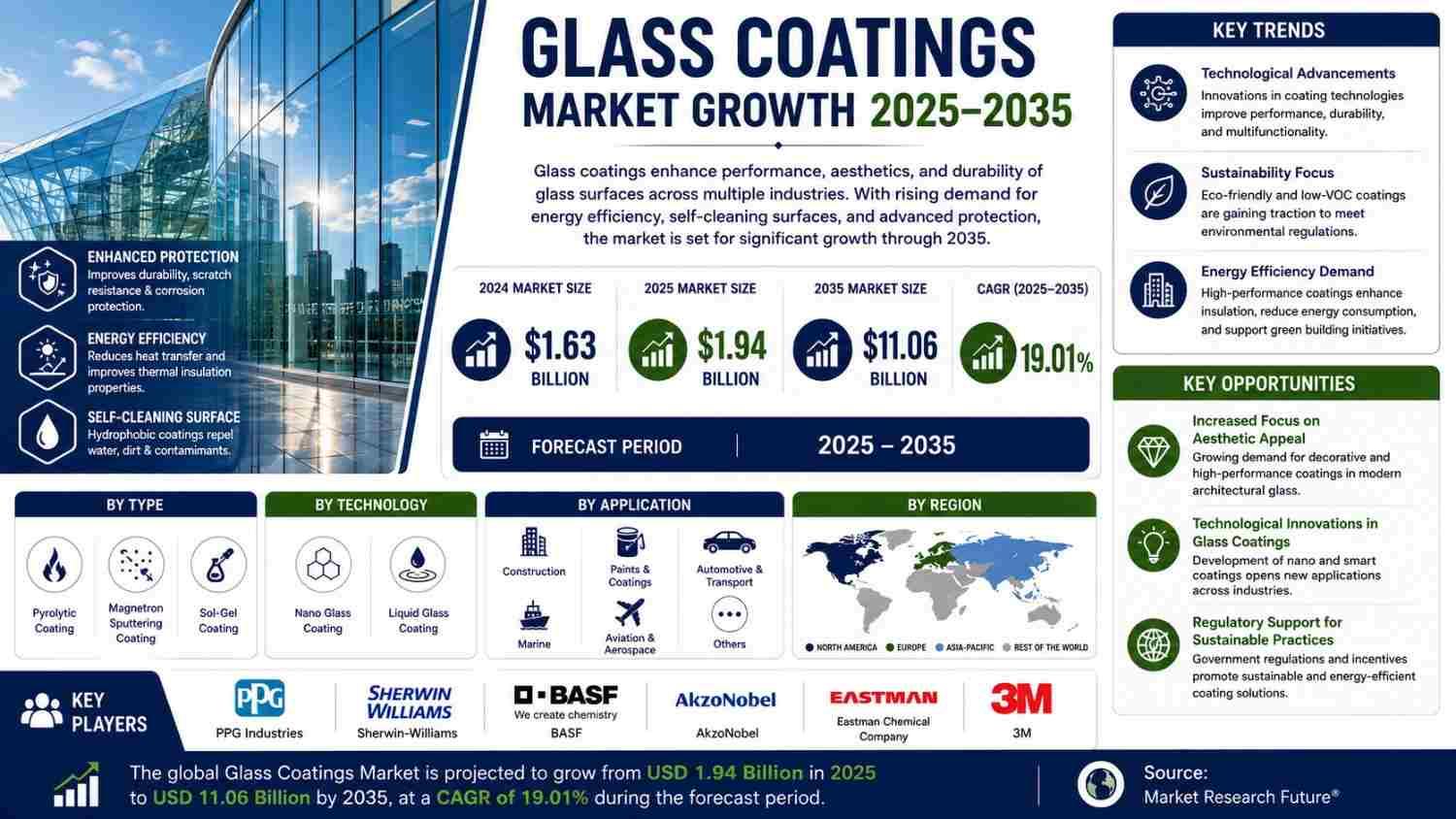
Glass Is Becoming a Performance Material
According to Market Research Future®, the Glass Coating Market was valued at $1.63 billion in 2024 and is projected to reach $1.94 billion in 2025 and $11.06 billion by 2035, registering a CAGR of 19.01% during 2025–2035. Technological advancements, sustainability focus, and rising demand for energy efficiency are influencing the market, while aesthetic requirements, coating innovation, and regulatory support for sustainable practices are creating opportunities. Major companies include PPG Industries, Sherwin-Williams, BASF, AkzoNobel, Eastman Chemical Company, and 3M.
Glass has traditionally been valued for transparency, appearance, and structural versatility. Increasingly, however, manufacturers and building designers expect glass to perform additional functions. Coatings can influence how surfaces interact with light, heat, moisture, dirt, chemicals, and the surrounding environment. That shift is expanding the role of coated glass across several industries.
Energy Efficiency Is Changing Glass Selection
Buildings are a major area of opportunity because windows and glazed facades influence thermal performance. Conventional glass can allow unwanted heat transfer, increasing the burden on heating and cooling systems.
Coatings can modify the optical and thermal characteristics of glass, helping designers manage solar exposure and improve building performance. The value of the coating therefore extends beyond the surface itself. It can contribute to decisions about energy consumption, occupant comfort, and building design.
This is particularly relevant as architects seek larger glazed surfaces without accepting proportionally higher energy requirements.
Construction Creates a Broad Application Base
Construction remains one of the most important application areas for glass coatings. Commercial buildings, residential developments, offices, hospitals, retail facilities, and other structures increasingly use architectural glass for both functional and aesthetic reasons.
Coatings can help address issues such as glare, solar heat, surface durability, and appearance. In some applications, they can also support easier maintenance.
The challenge is balancing performance with appearance and cost. Building owners may want highly functional surfaces, while architects often have specific requirements for color, reflectivity, transparency, and visual consistency.
Technology Determines Coating Performance
The market includes pyrolytic coating, magnetron sputtering coating, and sol-gel coating technologies. Each approach provides different characteristics and manufacturing considerations.
Pyrolytic coatings are applied during glass production and can provide durable surfaces. Magnetron sputtering allows manufacturers to deposit thin functional layers with controlled characteristics. Sol-gel approaches can offer flexibility for specific coating requirements.
Technology selection therefore depends on the desired performance, application, manufacturing process, and economics.
Nano Glass Coatings Expand Functional Possibilities
Nano glass coating technology has attracted attention because very thin functional layers can modify surface behavior without substantially changing the appearance of the underlying glass.
Potential functions include easier cleaning, water resistance, surface protection, and other specialized characteristics.
The commercial opportunity depends on demonstrating practical value. Customers need coatings that perform consistently over the expected service life rather than simply offering an attractive technical specification.
Automotive and Transport Applications Are Evolving
Glass coatings are also relevant to automotive and transport applications. Vehicle glass must balance visibility, comfort, durability, thermal performance, and appearance.
Coatings can help influence solar heat transmission and other surface characteristics. As vehicle manufacturers continue to incorporate larger glass areas and more sophisticated cabin designs, the performance requirements for automotive glass can become more demanding.
For coating suppliers, this creates opportunities for application-specific formulations and technologies.
Sustainability Is Becoming a Commercial Consideration
Sustainability is influencing the glass coatings industry in two ways. First, coatings can support more energy-efficient buildings and vehicles. Second, coating manufacturers themselves face pressure to improve production practices and material efficiency.
This creates a lifecycle perspective. A coating may have greater value when its contribution to energy performance is considered alongside its manufacturing impact.
Regulatory support for sustainable practices can further encourage adoption, particularly where building efficiency and environmental performance are becoming stronger purchasing considerations.
Aesthetic Appeal Creates Another Growth Path
Not every coating decision is driven by energy efficiency. Appearance remains important in architecture, automotive design, and specialty applications.
Coatings can influence reflectivity, color, surface appearance, and visual effects. This allows designers to pursue specific aesthetic outcomes while adding functional properties.
The combination of appearance and performance can make coatings more attractive than solutions designed around only one characteristic.
Competition Is Moving Toward Specialized Solutions
PPG Industries, Sherwin-Williams, BASF, AkzoNobel, Eastman Chemical Company, and 3M are among the companies participating in the competitive landscape.
Competition is likely to involve formulation expertise, coating durability, manufacturing consistency, application knowledge, and the ability to address customer-specific requirements.
As the market expands, suppliers may increasingly differentiate themselves through coatings designed for particular building, transport, marine, or aerospace conditions.
Challenges Remain
High-performance coatings can involve more sophisticated production processes and higher costs than untreated glass. Application consistency is another important consideration because defects can affect both appearance and performance.
Durability also matters. Customers need confidence that coatings will maintain their intended properties under weather exposure, cleaning, temperature changes, and other operating conditions.
These factors make quality control and product testing essential to long-term adoption.
The Market Outlook
The projected increase to $11.06 billion by 2035 indicates that glass coatings are moving beyond niche applications toward broader functional use.
The industry's deeper opportunity lies in transforming glass from a passive material into a surface capable of actively supporting energy efficiency, durability, aesthetics, and specialized performance. Companies that can demonstrate measurable benefits while controlling cost and maintaining coating reliability will be best positioned to capture this shift.
Related Reports
Russia Industrial Coatings Market

 Arabic
 French
 Spanish
 Portuguese
 Deutsch
 Turkish
 Dutch
 Italiano
 Russian
 Romaian
 Portuguese (Brazil)
 Greek