
Global Metal Fabrication Market Analysis by Metal Type and Process
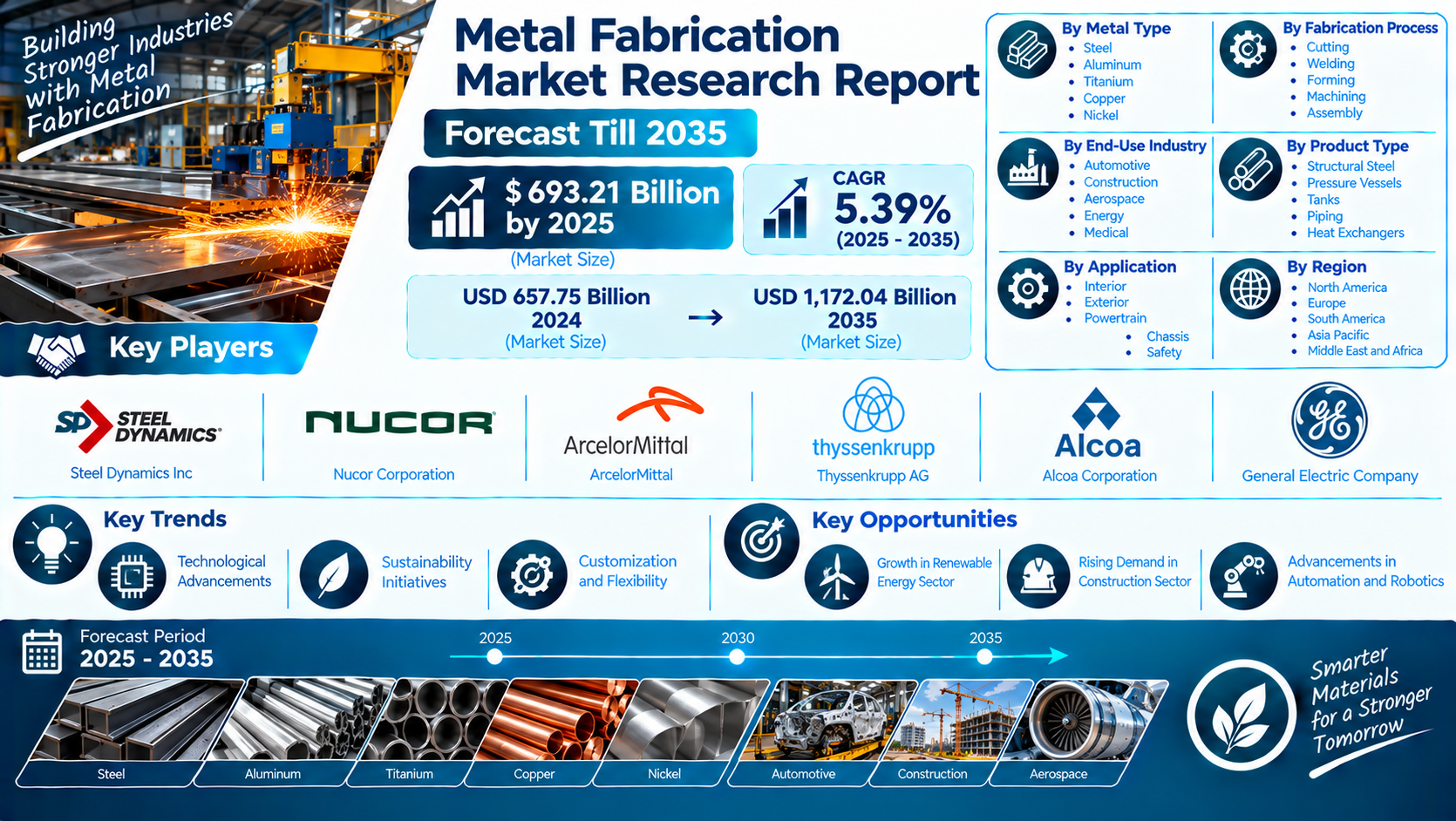
According to Market Research Future® (MRFR), the Metal Fabrication Market is projected to expand steadily as manufacturing, infrastructure development, transportation, and energy industries continue to require fabricated metal components and structures. The market was valued at USD 657.75 billion in 2024 and is expected to reach USD 693.21 billion in 2025 before growing to USD 1,172.04 billion by 2035. This represents a compound annual growth rate (CAGR) of 5.39% during the 2025–2035 forecast period. Technological advancements, sustainability initiatives, demand for customized products, and investment in renewable energy and construction are key factors shaping the industry's outlook.
Market Overview and Growth Drivers
Metal fabrication encompasses the processes used to transform raw metal into components, equipment, and finished structures. Cutting, welding, forming, machining, and assembly allow manufacturers to produce parts according to precise dimensional and performance requirements. These capabilities support a wide range of industries, from automotive manufacturing and construction to aerospace, energy, and medical equipment.
The projected increase in market value reflects the continued importance of fabricated metal products in industrial supply chains. Infrastructure projects require structural components, piping, tanks, and other engineered products, while manufacturers depend on fabricated parts for equipment and machinery. Demand is influenced by construction activity, industrial investment, production volumes, and the need to maintain or upgrade existing facilities.
Growth is not uniform across all market segments. Metal selection, fabrication complexity, quality standards, and project timelines affect production costs and purchasing decisions. Manufacturers must also manage fluctuations in raw-material prices, labor availability, energy costs, and delivery schedules. Businesses that combine efficient production with consistent quality and the flexibility to meet customer specifications may be better positioned to compete.
Metal Types and Fabrication Processes
The market is segmented by metal type into steel, aluminum, titanium, copper, and nickel. Steel remains an important material for structural applications and industrial equipment because of its broad range of grades and uses. Aluminum is relevant where weight reduction and corrosion resistance are important considerations, including transportation and selected construction applications. Titanium and nickel serve more specialized requirements, particularly where strength, heat resistance, or other material characteristics are essential. Copper is used in applications requiring electrical and thermal conductivity.
Each material presents different fabrication requirements. Differences in strength, weight, formability, corrosion behavior, and thermal properties influence tooling, process selection, and quality control. Fabricators must match these characteristics with the intended product and operating environment. Material choice can also affect project economics, since raw-material costs and processing complexity vary by metal and specification.
The fabrication process segment includes cutting, welding, forming, machining, and assembly. Cutting prepares material to the required dimensions, while welding joins components into structures or equipment. Forming changes the shape of metal, machining achieves specified dimensions and surface characteristics, and assembly brings individual parts together into completed products. These processes may be combined within a single production workflow.
Advances in automation, digital controls, and production equipment can improve repeatability and throughput. However, the benefits depend on the complexity of the work, investment costs, workforce skills, and the ability to integrate equipment with existing operations. Manufacturers must evaluate technology according to the products they produce rather than assume that one fabrication approach suits every application.
End-Use Industries and Product Applications
Automotive, construction, aerospace, energy, and medical industries are the principal end-use categories identified in the report. Automotive manufacturers use fabricated metal components across vehicle structures and systems, while construction projects require structural members and engineered metal products. Aerospace applications can demand strict tolerances and material traceability. Energy facilities require components designed for specific operating conditions, and medical equipment manufacturing can involve stringent quality requirements.
By product type, the market covers structural steel, pressure vessels, tanks, piping, and heat exchangers. Structural steel supports buildings and infrastructure, while pressure vessels and tanks serve industrial storage and process requirements. Piping and heat exchangers are important in facilities that transport fluids or transfer heat. Product demand depends on construction pipelines, industrial capacity additions, maintenance activity, and the technical specifications of individual projects.
The application segmentation includes interior, exterior, powertrain, chassis, and safety. These categories reflect the range of uses for fabricated metal components, particularly in products and systems that require structural integrity, dimensional accuracy, and dependable performance. Application requirements vary, so suppliers must maintain appropriate manufacturing controls and product documentation.
Technology, Sustainability, and Customization
Technological advancement is changing how fabricators plan and execute production. Automated cutting and welding, robotics, computer-controlled machining, and digital design tools can help reduce process variability and improve manufacturing efficiency. Automation may also support repeatable output in high-volume operations, while digital production planning can help coordinate complex jobs and material requirements.
Sustainability initiatives are another significant trend. Metal fabrication businesses may seek to reduce material waste, improve energy efficiency, and make better use of recyclable inputs. These measures can support resource efficiency, although their effectiveness depends on process design, equipment, energy sources, and material recovery systems. Companies must balance environmental objectives with production quality, operating costs, and delivery commitments.
Customization and flexibility are increasingly relevant where customers require products tailored to specific dimensions, designs, and operating conditions. Flexible production systems can help fabricators accommodate smaller batches and varying specifications. The challenge is to provide this adaptability without increasing costs or compromising consistency.
Regional Outlook and Competitive Landscape
The report divides the market into North America, Europe, South America, Asia Pacific, and the Middle East and Africa. Regional performance is shaped by manufacturing capacity, infrastructure spending, industrial development, labor costs, and access to metals and production technologies. The supplied figures do not provide regional market shares, so a numerical ranking of these regions cannot be established from the available information.
Key companies identified in the market include Steel Dynamics Inc, Nucor Corporation, ArcelorMittal, Thyssenkrupp AG, Alcoa Corporation, and General Electric Company. The supplied information does not specify individual market shares or rankings. Competition can depend on production capabilities, material access, engineering expertise, quality assurance, delivery reliability, and the ability to serve specialized customer needs.
Future Market Opportunities
Renewable energy development offers opportunities for fabricated metal structures and components used in energy infrastructure. Construction demand may support requirements for structural steel, piping, tanks, and other products. Automation and robotics also create opportunities for manufacturers seeking higher throughput, repeatability, and improved use of labor and materials.
With the market projected to reach USD 1,172.04 billion by 2035, the industry has a positive long-term growth outlook. Companies that invest selectively in technology, resource efficiency, customization, and dependable project execution may be better equipped to respond to changing industrial requirements.

 Arabic
 French
 Spanish
 Portuguese
 Deutsch
 Turkish
 Dutch
 Italiano
 Russian
 Romaian
 Portuguese (Brazil)
 Greek