
Green Chemicals Market to Reach USD 31.2 Billion by 2034
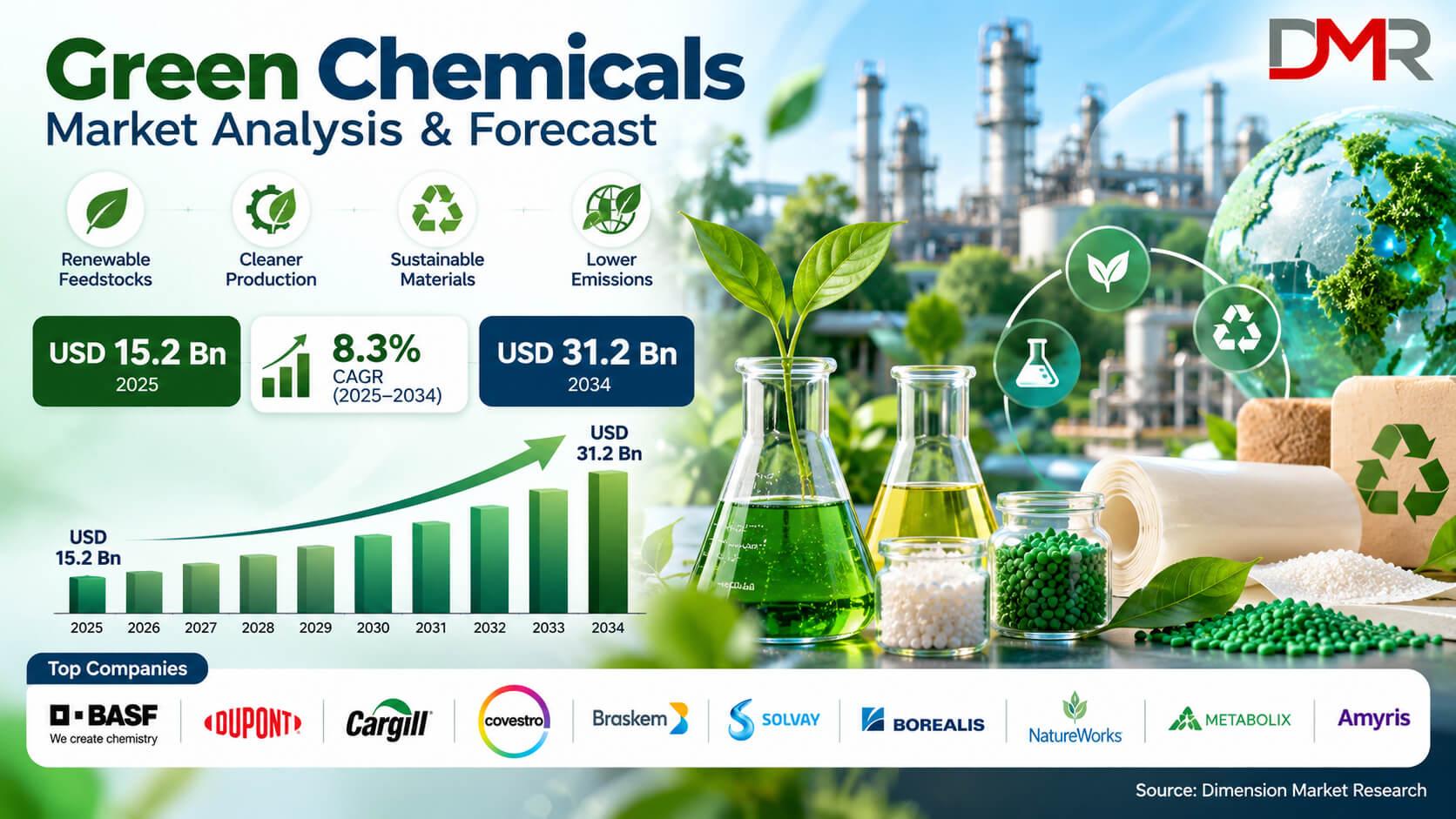
Green Chemicals Market Forecast: Industry Set to Reach USD 31.2 Billion by 2034
The Green Chemicals Market is projected to grow from USD 15.2 billion in 2025 to USD 31.2 billion by 2034, expanding at a compound annual growth rate (CAGR) of 8.3% from 2025 to 2034. According to Dimension Market Research, the sector is gaining momentum as manufacturers transition toward renewable feedstocks, bio-based intermediates and cleaner chemical production processes.
Green chemicals are becoming increasingly important as industries seek to reduce hazardous waste, lower carbon emissions and improve resource efficiency. Advances in industrial biotechnology, fermentation, enzymatic processing and biorefinery infrastructure are expanding the commercial potential of bio-alcohols, biopolymers and green solvents. These materials support applications in packaging, construction, automotive manufacturing, agriculture, pharmaceuticals and personal care. Although high production costs and feedstock availability remain challenges, regulatory initiatives, corporate sustainability commitments and growing demand for environmentally responsible products are creating new opportunities for chemical manufacturers worldwide.
Get free sample of this report (with custom data option)
Green Chemicals Market Snapshot
● The global market is valued at USD 15.2 billion in 2025.
● Market revenue is projected to reach USD 31.2 billion by 2034.
● The market is forecast to grow at an 8.3% CAGR from 2025 to 2034.
● The US market is expected to reach USD 2.8 billion in 2025.
● The US market is projected to grow at a 7.8% CAGR.
● Europe is forecast to reach USD 5.3 billion by 2034.
● Europe is projected to record a 9.9% CAGR from 2025 to 2034.
● Asia Pacific is expected to hold a 38.5% revenue share in 2025.
● Bio-alcohols are a leading product segment in the market.
● Packaging is a major end-use market for sustainable chemical materials.
Market Research Findings: Green Chemicals Industry Analysis
The green chemicals market research identifies renewable feedstocks, cleaner production technologies and sustainability-led procurement as important factors shaping industry development. Bio-alcohols benefit from established production capabilities and broad industrial applications, while plant-based raw materials offer established agricultural supply chains. Packaging represents a significant demand area as manufacturers explore bio-based plastics, recyclable materials and alternative coatings. Regionally, Asia Pacific is expected to lead in revenue share in 2025, while Europe is projected to record the highest regional CAGR. In the United States, government initiatives and research investments support the development of renewable chemical pathways. Competition is centered on process innovation, production scale, strategic partnerships and the ability to deliver sustainable materials at commercially competitive costs.
Why Is the Green Chemicals Market Growing?
Demand is increasing as governments, manufacturers and consumers place greater emphasis on environmental performance and resource efficiency. Regulations addressing chemical safety, pollution prevention and emissions encourage industries to consider alternatives to conventional petroleum-derived chemicals. At the same time, companies are integrating sustainability targets into product design and sourcing decisions.
Improvements in biotechnology and chemical engineering are helping producers convert agricultural residues, plant-based materials and other renewable resources into commercially useful chemicals. Investment in biorefineries, enzyme-based processing and fermentation technologies is also expanding the range of potential applications. These developments are strengthening the business case for green chemicals, particularly where regulatory compliance, product differentiation and reduced environmental impact influence purchasing decisions.
Key Growth Drivers in the Green Chemicals Market
● Stricter environmental regulations encourage cleaner chemical manufacturing.
● Consumer demand supports sustainable packaging and personal care products.
● Renewable feedstocks reduce reliance on fossil-derived chemical inputs.
● Biotechnology advances improve production efficiency and chemical yields.
● Corporate decarbonization targets encourage low-carbon material adoption.
● Government funding supports research and commercial-scale biorefineries.
● Circular economy initiatives increase demand for recyclable and bio-based materials.
Green Chemicals Market Research Scope and Leading Segments
The market is analyzed by product type, source, end-user and geographic region. These categories help explain where demand is emerging, which feedstocks support production and how manufacturers can identify growth opportunities across established and developing applications.
Bio-Alcohols: A Leading Product Segment
Bio-alcohols, including bioethanol and biobutanol, are projected to remain a leading product category because of their commercial maturity, established manufacturing capabilities and broad industrial relevance. Bioethanol can be produced from renewable resources such as corn, sugarcane and lignocellulosic biomass. Beyond fuel blending, bio-alcohols serve as intermediates for solvents, coatings, adhesives and other chemical products.
Existing production infrastructure and renewable fuel policies support demand in major markets, including the United States, Brazil and parts of Europe. Biobutanol is also attracting interest because of its higher energy density and potential compatibility with existing fuel infrastructure. Continued improvements in conversion efficiency and feedstock processing could expand the role of bio-alcohols in industrial decarbonization.
● Established manufacturing infrastructure supports commercial availability.
● Renewable feedstocks offer alternatives to fossil-based inputs.
● Industrial applications extend beyond transportation fuels.
Plant-Based Feedstocks: An Established Source Category
Plant-based materials are expected to remain an important source of green chemicals because agricultural supply chains are already established in many major producing countries. Corn, sugarcane, soybeans, rapeseed and wheat can provide raw materials for bioethanol, biopolymers, bio-based solvents and other renewable products. Existing farming, processing and logistics networks can help manufacturers scale production more efficiently than some emerging feedstock pathways.
Plant-based production also supports the development of materials used in packaging, textiles, consumer products and transportation. However, producers must consider land use, water consumption, crop availability and potential competition with food production. Agricultural residues and improved conversion technologies may help diversify supply while improving resource efficiency.
● Established agricultural networks support feedstock availability.
● Plant-derived materials serve multiple chemical applications.
● Responsible sourcing remains important for long-term sustainability.
Read the full Green Chemicals Market Research Report: https://dimensionmarketresearch.com/report/green-chemicals-market
Green Chemicals Market Dynamics: Trends, Opportunities and Challenges
Market Trend: Transition Toward Renewable Feedstocks
Manufacturers are increasingly exploring plant-derived materials, agricultural residues and other renewable feedstocks to reduce dependence on fossil resources. This transition is supported by advances in biotechnology, catalysis and biomass conversion. Producers are also evaluating the environmental impact of chemicals across their life cycles, rather than focusing solely on the raw materials used during production.
Bio-based polymers, solvents and intermediates are gaining attention across packaging, automotive, construction and consumer goods. However, environmental performance depends on factors such as feedstock sourcing, energy consumption, processing methods and end-of-life treatment. Companies that assess these factors carefully can better align product development with customer expectations and sustainability requirements.
Market Opportunity: Bioplastics and Sustainable Packaging
Demand for alternative packaging materials creates opportunities for chemical producers and technology developers. Bio-based polymers, including polylactic acid (PLA), polyhydroxyalkanoates (PHA) and starch-based blends, can be used in selected packaging applications. Their commercial potential is influenced by material performance, cost competitiveness and compatibility with existing production systems.
Investment in biorefineries, microbial fermentation, enzyme catalysis and improved polymer processing could expand product availability and reduce manufacturing costs. Partnerships between chemical companies, packaging manufacturers and research institutions may also help accelerate commercialization. Companies that combine suitable material properties with reliable supply and appropriate waste-management pathways are positioned to pursue emerging demand.
Market Challenge: Production Costs and Scale-Up
High production costs remain a major barrier to wider adoption. Green chemical manufacturing can require specialized equipment, intensive research and development, reliable renewable feedstocks and substantial investment in biorefinery infrastructure. Conventional petrochemical producers often benefit from established facilities, integrated supply chains and economies of scale, making price competition difficult in commodity applications.
Feedstock seasonality, transport costs, energy price volatility and differences in regional regulations can further complicate commercialization. Some bio-based products also require specialized end-of-life infrastructure to achieve their intended environmental benefits. Greater process efficiency, diversified sourcing, industrial partnerships and supportive policy frameworks will be important for improving competitiveness over time.
Regional and Country Outlook for the Green Chemicals Market
Regional performance reflects differences in industrial capacity, renewable feedstock availability, regulatory support and investment in sustainable chemical production. The United States, Europe and Japan represent important markets, each with distinct growth opportunities.
United States Green Chemicals Market
The US green chemicals market is projected to reach USD 2.8 billion in 2025, with a CAGR of 7.8% over the forecast period. Federal sustainability initiatives, agricultural feedstock availability and industrial research capabilities support the development of bio-based chemicals for packaging, agriculture, automotive and personal care applications.
Europe Green Chemicals Market
The European green chemicals market is estimated at USD 2.2 billion in 2025 and is projected to reach USD 5.3 billion by 2034, registering a CAGR of 9.9%. The European Green Deal, circular economy policies and demand for lower-carbon industrial materials support the region's growth outlook.
Japan Green Chemicals Market
The Japanese market is projected to reach USD 912.0 million in 2025 and USD 1,760.0 million in 2034, advancing at a CAGR of 7.6%. Government-backed innovation, advanced manufacturing and investment in bio-based polymers and resource-efficient chemical processes support its development.
Key Competitor Companies in the Green Chemicals Market
Competition is shaped by product innovation, production capacity, strategic partnerships and the ability to supply commercially competitive renewable chemicals. Key companies identified in the market research include:
● BASF SE
● Dow Inc.
● Cargill, Incorporated
● Evonik Industries AG
● DuPont de Nemours, Inc.
● Novozymes A/S
● Corbion N.V.
● Amyris, Inc.
● Braskem S.A.
● Eastman Chemical Company
● Clariant AG
● Arkema S.A.
● PTT Global Chemical Public Company Limited
● Avantium N.V.
● GFBiochemicals
● Genomatica, Inc.
● Metabolic Explorer S.A.
● Borregaard ASA
● Mitsubishi Chemical Holdings Corporation
These companies participate in different areas of the broader sustainable chemicals industry. Their competitive strategies include research and development, renewable feedstock integration, portfolio expansion and collaboration with downstream manufacturers. Individual market positions and market shares should be verified against the full report.
Get 10% instant discount on report purchase
Explore more reports:
● Battery Electrolyte Chemistry Market Emerging Trends and Investor Insights
● Europe Solid State Battery Market Emerging Trends and Investor Insights
● Battery as a Service Market Emerging Trends and Investor Insights
● Battery Management System Market Emerging Trends and Investor Insights
● Europe Hypochlorous Acid Market Emerging Trends and Investor Insights
FAQ's
1. What is the green chemicals market size in 2025?
According to Dimension Market Research, the global green chemicals market is projected to reach USD 15.2 billion in 2025.
2. What is the green chemicals market forecast for 2034?
The market is projected to reach USD 31.2 billion by 2034, reflecting growing demand for renewable and sustainable chemical products.
3. What is the CAGR of the green chemicals market?
The global green chemicals market is forecast to register a compound annual growth rate of 8.3% from 2025 to 2034.
4. What factors are driving green chemicals market growth?
Environmental regulations, renewable feedstock adoption, biotechnology advances, consumer sustainability preferences and corporate decarbonization targets support market growth.
5. Which region is expected to dominate the green chemicals market?
Asia Pacific is projected to account for 38.5% of global green chemicals market revenue in 2025, supported by industrial demand and feedstock availability.
6. Which region is expected to record the highest CAGR?
Europe is projected to record the highest regional CAGR at 9.9% over the 2025 to 2034 forecast period.
7. Which product segment leads the green chemicals market?
Bio-alcohols are projected to remain a leading product category due to established production infrastructure and their applications across fuels and industrial chemicals.
8. What are the major applications of green chemicals?
Major applications include packaging, construction, automotive, agriculture, healthcare, pharmaceuticals, personal care, paints and coatings, and food and beverages.
9. What challenges affect the green chemicals market?
High production costs, scale-up difficulties, feedstock competition, energy price volatility and limited infrastructure can restrict wider adoption.
10. Which companies are key players in the green chemicals market?
Major companies include BASF SE, Dow Inc., Cargill, Evonik Industries, DuPont, Corbion, Braskem and Mitsubishi Chemical Holdings Corporation.
About Us
Dimension Market Research (DMR) is a global market intelligence and consulting firm delivering data-driven insights that help organizations make informed strategic decisions. With expertise across 12+ industries and global markets, DMR provides syndicated reports, custom research, competitive analysis, white space analysis, and business strategy consulting.
Our research solutions combine analytical rigor, industry expertise, and forward-looking intelligence to identify opportunities, reduce risks, and support sustainable growth. Trusted by clients across diverse sectors, DMR is committed to delivering accurate, actionable insights that enable businesses to navigate evolving market landscapes with confidence.
Contact Us
Phone USA: +17323699777
Phone India: +919310023843
E-mail: enquiry@dimensionmarketresearch.com
Address USA: 957 Route 33, Suite 12 #308, Hamilton Square, NJ-08690
Address India: D44, Sector 6, Noida 201301, India

 Arabic
 French
 Spanish
 Portuguese
 Deutsch
 Turkish
 Dutch
 Italiano
 Russian
 Romaian
 Portuguese (Brazil)
 Greek