
Process Heating Equipment Market Trends: Electrification and Fuel Diversification
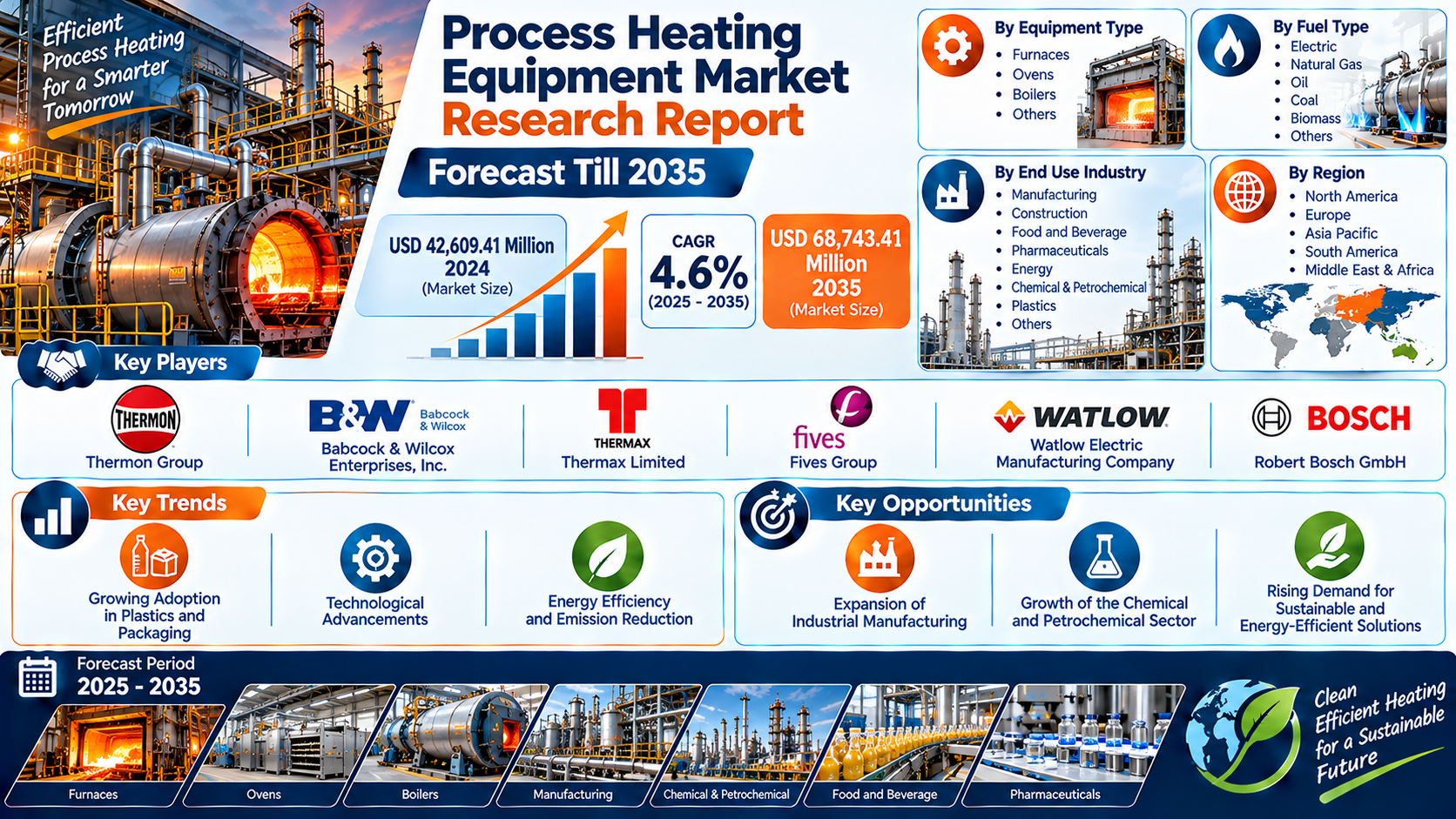
According to Market Research Future® (MRFR), the Process Heating Equipment Market is projected to grow from USD 42,609.41 Million in 2024 to USD 68,743.41 Million by 2035, registering a compound annual growth rate (CAGR) of 4.6% during the forecast period from 2025 to 2035. Process heating equipment is essential across industrial operations that require controlled heat for transforming raw materials, processing products and maintaining production conditions. Expansion in industrial manufacturing and the chemical and petrochemical sectors is expected to support demand, while growing adoption in plastics and packaging represents an important market trend.
Industrial Heat as a Core Production Requirement
Process heating refers to the application of thermal energy during manufacturing and industrial activities. It supports operations such as melting, drying, curing, baking, distillation, evaporation, sterilisation and material treatment. Equipment selection depends on the temperature required, production capacity, process design, fuel availability and the characteristics of the material being handled.
Manufacturing industries rely on controlled heat to maintain product quality and process consistency. In metals and materials production, heating systems support thermal treatment and other high-temperature operations. Food and beverage facilities use heat for cooking, drying, pasteurisation and related processing stages. Pharmaceutical manufacturing requires carefully controlled thermal conditions for selected production, cleaning and sterilisation processes. Chemical and petrochemical plants use process heat in reactors, separation systems and other production equipment.
The breadth of these applications gives the market exposure to several industrial sectors. As production facilities expand or modernise, companies may invest in new heating systems, replace ageing equipment or upgrade existing installations to improve operational performance.
Equipment Types Serve Different Industrial Processes
The market is segmented by equipment type into Furnaces, Ovens, Boilers and Others. Each category serves different heating requirements and operating environments.
Furnaces are used in processes requiring controlled or high-temperature heating. They are relevant to metal processing, material treatment and several industrial manufacturing operations. Furnace design varies according to the process, temperature range, heat-transfer method and material being heated. Industrial users evaluate thermal uniformity, energy consumption, operating reliability and maintenance requirements when selecting a furnace.
Ovens provide controlled heating for applications such as drying, curing, baking and thermal processing. They are used in manufacturing environments where temperature management and consistent treatment are important to product quality. Industrial ovens can be designed for batch or continuous operation, depending on production requirements and the characteristics of the material.
Boilers generate steam or hot water for industrial processes and facility operations. Steam can provide thermal energy for heating, cleaning, processing and other applications. Boiler selection depends on required output, pressure, fuel type, operating efficiency and safety requirements. The Others category covers additional process heating equipment included in the report's classification.
Fuel Choices Influence Operating Economics
Fuel type segmentation includes Electric, Natural Gas, Oil, Coal, Biomass and Others. The choice of energy source has a direct effect on operating costs, equipment design and emissions characteristics.
Electric heating systems convert electrical energy into heat and can provide precise temperature control in suitable applications. Their operating economics depend on electricity prices, grid reliability, equipment efficiency and the availability of suitable electrical infrastructure. Electric systems may also be considered where companies are evaluating changes to their energy mix or seeking to reduce direct combustion at the point of use.
Natural gas remains an established fuel for industrial heating because it can support a range of combustion-based processes. Oil and coal are also used in certain industrial settings, depending on equipment configuration, fuel availability and local requirements. Biomass offers another option where appropriate feedstock and handling infrastructure are available. Its suitability depends on fuel consistency, moisture content, combustion technology, emissions controls and supply reliability.
Fuel selection is becoming increasingly important as industrial companies assess energy costs, operational resilience and environmental performance. A transition between fuel types may require changes to burners, boilers, storage systems, electrical connections and emissions-control equipment. The best option is therefore specific to each facility and process.
End-Use Industries Create Diverse Demand
The end-use industry segmentation covers Manufacturing, Construction, Food and Beverage, Pharmaceuticals, Energy, Chemical and Petrochemical, Plastics and Others. Manufacturing provides a broad demand base because thermal energy is required in numerous production processes. Construction-related industrial activity also supports demand for heating equipment used in material production and processing.
Food and beverage facilities use process heat to prepare, preserve and transform products. Temperature control is important for maintaining product characteristics and meeting applicable processing requirements. Pharmaceutical production uses specialised heating equipment in processes where consistent operating conditions and validated procedures are essential.
Energy facilities require thermal systems for selected generation, processing and supporting operations. Chemical and petrochemical plants use process heating in a range of production stages, including heating feedstocks and maintaining reaction conditions. These facilities can require equipment designed for demanding temperatures, operating schedules and safety specifications.
Plastics manufacturing is another relevant end-use segment. Heating is central to processes such as extrusion, moulding and material preparation. The growing adoption of process heating equipment in plastics and packaging is an identified market trend. Production growth and changes in packaging requirements can create demand for equipment that supports consistent thermal conditions and manufacturing throughput.
Manufacturing and Chemical Sector Expansion Offer Opportunities
Expansion of industrial manufacturing is a major opportunity for process heating equipment suppliers. New production capacity can require furnaces, ovens, boilers and associated thermal systems. Modernisation of existing plants can also generate demand for equipment replacement, automation and improved process control.
The chemical and petrochemical sector represents another opportunity. These industries rely on thermal energy in multiple stages of production and processing. Capacity additions, plant upgrades and changes in product requirements can influence investment in heating systems. Suppliers may need to provide equipment suited to specific process temperatures, fuels, operating pressures and safety requirements.
The plastics and packaging trend also creates opportunities for manufacturers of industrial ovens, heaters and related equipment. As producers seek consistent output and efficient production lines, equipment performance, controllability and integration with wider manufacturing systems become important purchasing considerations.
Competitive Landscape and Technology Priorities
Key players identified in the Process Heating Equipment Market include Thermon Group, Babcock & Wilcox Enterprises, Inc., Thermax Limited, Fives Group, Watlow Electric Manufacturing Company and Robert Bosch GmbH. Competition is influenced by equipment reliability, thermal performance, fuel flexibility, engineering capabilities and after-sales support.
Technology development can help suppliers improve temperature control, automation, energy management and equipment monitoring. Industrial customers increasingly assess heating systems as part of a broader production process rather than as standalone assets. Integration with process controls and maintenance systems can support operational visibility and help identify performance issues.
Energy efficiency is also an important consideration for equipment buyers. However, efficiency improvements depend on process design, heat recovery opportunities, operating conditions and maintenance practices. Companies must evaluate total lifecycle costs, including installation, fuel or electricity consumption, servicing and downtime.
Market Outlook to 2035
The Process Heating Equipment Market is projected to reach USD 68,743.41 Million by 2035, compared with USD 42,609.41 Million in 2024, with a forecast CAGR of 4.6% during 2025–2035. Industrial manufacturing expansion, chemical and petrochemical sector growth and demand from plastics and packaging are expected to remain important influences.
Demand will vary according to regional industrial activity, fuel economics, equipment replacement cycles and investment in production capacity. Suppliers that provide reliable heating systems, suitable fuel options and application-specific engineering support can strengthen their position as industrial customers modernise thermal operations.

 Arabic
 French
 Spanish
 Portuguese
 Deutsch
 Turkish
 Dutch
 Italiano
 Russian
 Romaian
 Portuguese (Brazil)
 Greek