
Collagen Supplement Market: Growing Interest in Beauty Nutrition and Functional Wellness Creates New Opportunities
From hydrolyzed collagen powders and ready-to-drink shots to capsules and chewable gummies, manufacturers are expanding product options to meet different consumer preferences. Ingredient sourcing, peptide composition, product quality, and clinical research are also becoming important factors influencing purchasing decisions.
Collagen Supplement Market Size and Growth Forecast
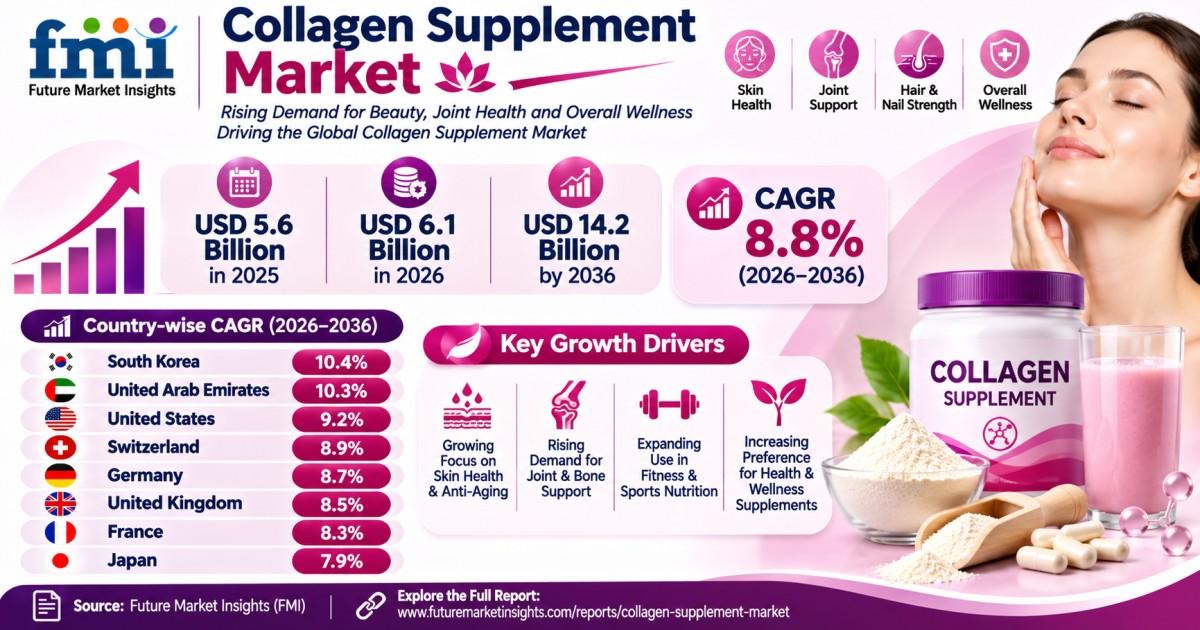
According to Future Market Insights, the global collagen supplement market is estimated to reach USD 6.1 billion in 2026, increasing from USD 5.6 billion in 2025. The market is projected to reach USD 14.2 billion by 2036, registering a compound annual growth rate (CAGR) of 8.8% between 2026 and 2036.
This growth reflects rising interest in functional nutrition and products designed for specific wellness requirements. Consumers are increasingly considering collagen supplements as part of their regular beauty, fitness, and healthy-aging routines.
Manufacturers are responding through product innovation, including specialized peptide formulations, improved solubility, and multiple delivery formats. The growing availability of collagen products through online platforms, pharmacies, and specialty retailers is also supporting market development.
Five Major Trends Shaping the Collagen Supplement Industry
1. Bovine Collagen Remains a Leading Ingredient Source
Bovine cattle hide collagen is expected to account for 46.0% of the collagen supplement market by source origin in 2026.
Its established supply base and suitability for producing hydrolyzed collagen peptides support its use across finished supplement formulations. Bovine collagen is commonly incorporated into powders and other products designed for everyday consumption.
Marine collagen, sourced from fish skin and scales, also provides opportunities for manufacturers targeting consumers interested in alternative ingredient origins. At the same time, ingredient traceability, sourcing standards, and certification requirements are becoming important considerations for brands.
2. Type I and III Collagen Leads by Collagen Type
Type I and III Beauty Skin and Hair Hydrolysate is projected to represent 58.0% of the collagen type segment in 2026.
These collagen types are widely used in formulations positioned around skin, hair, and beauty nutrition. Manufacturers are developing hydrolysates with specific peptide characteristics and improved solubility for convenient daily consumption.
Growing interest in beauty-from-within products is also encouraging brands to combine collagen ingredients with other nutritional components. Product differentiation increasingly depends on formulation quality, ingredient specifications, and credible research supporting permitted product claims.
3. Hydrolyzed Peptide Powders Maintain Strong Demand
Hydrolyzed Peptides Powder is expected to account for 52.0% of the product form segment in 2026.
Powder formats allow consumers to incorporate multi-gram servings into coffee, smoothies, and other beverages. They also offer manufacturers flexibility in developing different flavours, ingredient combinations, and serving sizes.
Companies are focusing on solubility, taste, texture, and packaging convenience to improve the consumer experience. Single-serve sachets and larger canisters provide options for both occasional use and regular supplementation.
Ready-to-drink collagen liquids, capsules, tablets, and chewable gummies are also contributing to product diversification.
4. Skin Hydration and Anti-Aging Remain Important Consumer Interests
Skin Elasticity Hydration and Anti-Aging is projected to account for 48.0% of the clinical benefit segment in 2026.
Consumer interest in beauty nutrition is supporting demand for collagen products positioned around skin-related wellness. This has encouraged manufacturers to develop formulations featuring hydrolyzed peptides and complementary ingredients.
The market is also expanding beyond beauty applications. Joint mobility, bone density, muscle recovery, and hair and nail strengthening are creating additional opportunities for specialized supplement products.
Brands need to communicate product benefits responsibly and ensure that health-related marketing claims are supported by appropriate evidence and comply with applicable regulations.
5. Direct-to-Consumer and Specialty Retail Channels Gain Importance
Direct-to-Consumer E-Commerce and Specialty Retailers are expected to account for 49.0% of the distribution channel segment in 2026.
Online platforms allow consumers to compare ingredient origins, product specifications, serving information, and available quality documentation before purchasing.
Subscription services and recurring delivery options also make it easier for customers to maintain regular supplement routines. Specialty retailers provide another important route to market by offering a wider selection of formulations and targeted products.
For manufacturers, combining digital distribution with specialist retail partnerships can help improve product visibility and reach different consumer groups.
Which Countries Offer Growth Opportunities in the Collagen Supplement Market?
The collagen supplement market is developing across several regions, with country-level growth influenced by consumer preferences, functional food regulations, retail structures, and ingredient sourcing.
According to Future Market Insights, the projected country-level CAGRs for 2026–2036 include:
· South Korea: 10.4%
· United Arab Emirates: 10.3%
· United States: 9.2%
· Switzerland: 8.9%
· Germany: 8.7%
· United Kingdom: 8.5%
· France: 8.3%
· Japan: 7.9%
South Korea is projected to record the highest growth among the profiled countries. Demand is supported by interest in ingestible beauty products, functional collagen formats, and the country's health functional food market.
The United Arab Emirates offers opportunities for halal-certified bovine and marine collagen products, particularly through pharmacies and specialist beauty channels.
In the United States, demand for collagen powders and convenient daily-use formats is contributing to market development. Switzerland and Germany offer opportunities through established health retail channels and interest in quality-focused formulations.
The United Kingdom and France are also important markets, with pharmacies, specialty wellness retailers, and online platforms supporting product availability. Japan's market continues to benefit from established consumer familiarity with functional nutrition and collagen products.
Key Drivers and Challenges in the Collagen Supplement Market
Growing interest in preventive wellness, beauty nutrition, and healthy aging is supporting demand for collagen supplements. Consumers are increasingly looking for products that can be incorporated into everyday routines, while sports nutrition and joint health applications are creating additional areas of interest.
Ingredient innovation is another important growth factor. Manufacturers are exploring lower-molecular-weight peptides, marine collagen, specialized collagen blends, and fermentation-derived alternatives to serve different consumer requirements.
However, the market also faces challenges. Manufacturers must maintain consistent ingredient quality, manage raw material costs, and meet applicable food safety and labelling requirements.
Another important consideration is the substantiation of health-related claims. Companies need to distinguish between supported research findings and claims that have not been adequately demonstrated. Clear product information and responsible marketing can help build consumer confidence.
Request full Report Pricing and Sample Report:
https://www.futuremarketinsights.com/reports/sample/rep-gb-14671
Competitive Landscape of the Collagen Supplement Market
The global collagen supplement industry includes ingredient manufacturers, specialized peptide producers, and consumer-facing nutrition brands.
Companies covered in the Future Market Insights report include:
· VitalProteins LLC (Nestlé Health Science)
· Rousselot (Darling Ingredients)
· Gelita AG
· Sports Research Corporation
· Ancient Nutrition
· GELCO International
· Nitta Gelatin Inc.
· PB Leiner (Tessenderlo Group)
· Weishardt Group
· BioCell Technology LLC
Competition is influenced by ingredient sourcing, peptide research, manufacturing capabilities, product quality, and distribution reach.
Ingredient suppliers are focusing on specialized hydrolysis technologies and traceable raw materials, while consumer brands are expanding their portfolios across powders, liquid shots, capsules, and other formats.
Companies are also exploring new formulations for beauty nutrition, joint health, and active aging. These developments are creating opportunities for collaboration between ingredient producers, supplement manufacturers, and specialist retailers.
What Is the Future Outlook for the Collagen Supplement Market?
The collagen supplement market is expected to continue expanding as consumers explore functional nutrition products for beauty, mobility, and overall wellness.
Bovine collagen remains an important source category, while Type I and III hydrolysates and hydrolyzed peptide powders hold leading positions across their respective segments. Direct-to-consumer e-commerce and specialty retail are also expected to remain important distribution channels.
Looking ahead, product innovation, ingredient traceability, clinical research, and convenient delivery formats will influence competition. Manufacturers that respond to changing consumer preferences while maintaining responsible product claims and consistent quality will be better positioned to explore emerging opportunities.
For detailed market estimates, segment analysis, country-level forecasts, and competitive insights, explore the https://www.futuremarketinsights.com/reports/collagen-supplements-market
The report provides an in-depth assessment of the global collagen supplement industry from 2026 to 2036, covering source origins, collagen types, product forms, clinical benefits, distribution channels, regional developments, and key companies.

 English
 Arabic
 French
 Spanish
 Portuguese
 Deutsch
 Turkish
 Italiano
 Russian
 Romaian
 Portuguese (Brazil)
 Greek