
Global Plastic Resin Market Forecast: Key Trends, Applications, and Industry Opportunities Through 2035
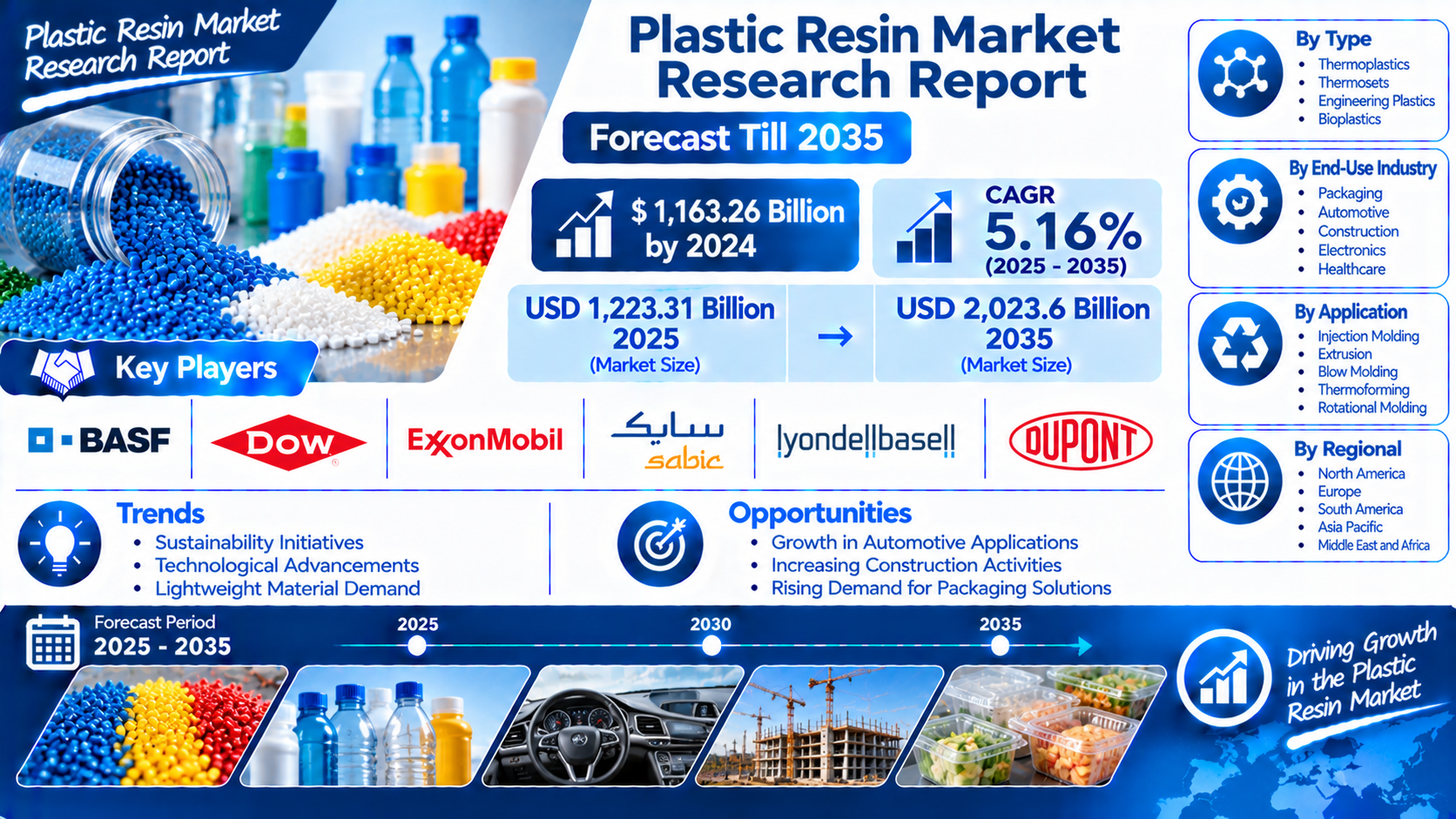
According to Market Research Future® (MRFR), the Plastic Resin Market was valued at USD 1,163.26 billion in 2024 and is projected to increase from USD 1,223.31 billion in 2025 to USD 2,023.6 billion by 2035. The market is expected to register a compound annual growth rate (CAGR) of 5.16% during the 2025–2035 forecast period. Plastic resins are essential raw materials for manufacturing a broad range of products, serving industries such as packaging, automotive, construction, electronics, and healthcare. Their adaptability, processing flexibility, and ability to meet varied performance requirements support demand across these sectors. Sustainability initiatives, technological advancements, and growing interest in lightweight materials are also influencing product development and market opportunities.
Plastic Resin Market Overview
Plastic resins are polymer-based materials used to produce finished and intermediate goods through manufacturing processes such as injection molding, extrusion, and blow molding. Their properties can be adjusted through resin selection, formulation, additives, and processing conditions. This flexibility allows manufacturers to produce materials with different levels of strength, durability, flexibility, thermal resistance, and other characteristics required by specific applications.
The market includes several resin categories, each serving distinct manufacturing requirements. Thermoplastics are widely processed through heating and cooling, allowing them to be reshaped under suitable conditions. Thermosets undergo curing and form structures that cannot be remelted and reshaped in the same way. Engineering plastics are selected for applications that require more demanding mechanical or thermal performance, while bioplastics represent a category associated with biological feedstocks, biodegradability, or both, depending on the specific material.
Demand is influenced by the production requirements of downstream industries. Manufacturers evaluate resin costs, availability, processing efficiency, product specifications, and regulatory considerations when selecting materials. These factors make the market closely connected to industrial output, consumer demand, infrastructure investment, and developments in manufacturing technology.
Resin Types and Material Characteristics
Thermoplastics form an important category because of their versatility and compatibility with several processing techniques. They are used in packaging, construction components, automotive parts, and consumer products. Their ability to be reheated and reshaped under appropriate conditions can support manufacturing flexibility and material recovery, although actual recyclability depends on polymer composition, product design, contamination, and available recycling infrastructure.
Thermosets are used where cured material properties are important. Once cross-linked, these materials generally maintain their formed structure when exposed to heat rather than melting like conventional thermoplastics. Their applications depend on the specific resin formulation and performance requirements of the finished product.
Engineering plastics serve applications that demand characteristics beyond those commonly required of commodity materials. Strength, dimensional stability, chemical resistance, and heat performance can influence their selection in automotive, electronics, and industrial components. Bioplastics provide another area of development, with material properties and environmental characteristics varying across different resin families. Bio-based content does not automatically mean a plastic is biodegradable, and biodegradability does not guarantee that a product will break down in every natural environment.
End-Use Industries Supporting Demand
Packaging is a major end-use category for plastic resins because manufacturers use these materials in containers, films, protective packaging, and other formats. Resin selection depends on factors such as flexibility, barrier performance, strength, transparency, processing requirements, and product protection. Demand for packaging solutions creates opportunities for material suppliers to develop products that address both functional requirements and changing sustainability expectations.
The automotive industry uses plastic resins in components where weight, design flexibility, and performance are important. Lightweight materials can help reduce vehicle mass, although the suitability of a resin depends on the component's structural, thermal, safety, and durability requirements. Construction is another important end-use sector, with resins used in products and components that require durability, weather resistance, insulation, or specific installation characteristics.
Electronics manufacturers use selected resins in housings, connectors, insulation, and other components. Material requirements can include dimensional stability, electrical properties, and resistance to operating conditions. Healthcare applications also require carefully specified materials, with selection influenced by the intended use, compatibility, regulatory requirements, and relevant quality standards.
Applications and Processing Methods
The market's application segmentation includes injection molding, extrusion, blow molding, thermoforming, and rotational molding. Injection molding is used to manufacture components with defined shapes and dimensions by injecting molten material into a mold. It is relevant to a broad range of products across automotive, electronics, healthcare, and consumer applications.
Extrusion produces continuous profiles and products by pushing material through a shaped opening. It is used in manufacturing films, pipes, sheets, and other continuous forms. Blow molding is commonly associated with hollow plastic products, including bottles and containers. Thermoforming shapes heated plastic sheets over or into molds, while rotational molding produces hollow products through the movement of material within a heated mold.
The appropriate process depends on resin properties, product geometry, production volume, equipment, and cost considerations. Processing technology and resin formulation therefore need to be considered together when manufacturers seek to improve product quality and manufacturing efficiency.
Trends and Growth Opportunities
Sustainability initiatives are influencing resin production, product design, and material sourcing. Manufacturers are examining recycled content, improved collection and processing systems, and alternative feedstocks. The effectiveness of these approaches depends on the availability and quality of recovered materials, sorting capabilities, product design, and end-market demand. Bioplastics are also attracting attention, although their environmental benefits need to be evaluated according to feedstock, production methods, disposal conditions, and the properties of each material.
Technological advancements provide opportunities to improve resin performance and processing efficiency. Developments in polymer formulation, manufacturing equipment, and quality control can help suppliers address increasingly specific customer requirements. Lightweight material demand is another important trend, particularly in automotive applications where reducing component weight can support vehicle efficiency. The performance and lifecycle requirements of each component remain essential to material selection.
Growth in automotive applications, increasing construction activities, and rising demand for packaging solutions are identified as major opportunities. These sectors require materials with different combinations of performance, cost, and processing characteristics, creating opportunities for both established resin categories and newer formulations.
Regional Outlook and Competitive Landscape
The market is segmented across North America, Europe, South America, Asia Pacific, and the Middle East and Africa. Regional demand reflects differences in manufacturing capacity, construction activity, automotive production, packaging consumption, and investment in industrial infrastructure. Asia Pacific is an important manufacturing region, while North America and Europe have established industrial and downstream markets. South America and the Middle East and Africa also provide opportunities linked to industrial development and demand from end-use sectors.
Key companies identified in the market include BASF, Dow, ExxonMobil, SABIC, LyondellBasell, and DuPont. Competition is shaped by product portfolios, resin performance, production capabilities, technological development, customer relationships, and supply-chain strength. Companies may also pursue sustainability-related initiatives and material innovation to respond to evolving customer requirements.
Market Outlook Through 2035
The Plastic Resin Market is projected to expand from USD 1,223.31 billion in 2025 to USD 2,023.6 billion by 2035, representing a CAGR of 5.16%. Demand from packaging, automotive, construction, electronics, and healthcare will continue to influence material requirements. Sustainability initiatives, technological advancements, and lightweight material demand are expected to remain important themes. Suppliers that balance product performance, manufacturing efficiency, material availability, and environmental considerations will be positioned to address changing needs across the global resin value chain.

 English
 Arabic
 French
 Spanish
 Deutsch
 Turkish
 Dutch
 Italiano
 Russian
 Romaian
 Portuguese (Brazil)
 Greek