
Revenue Operations Software Market to Surpass USD 29,117.2 Million by 2036 as AI-Driven Revenue Intelligence and Sales Automation Accelerate
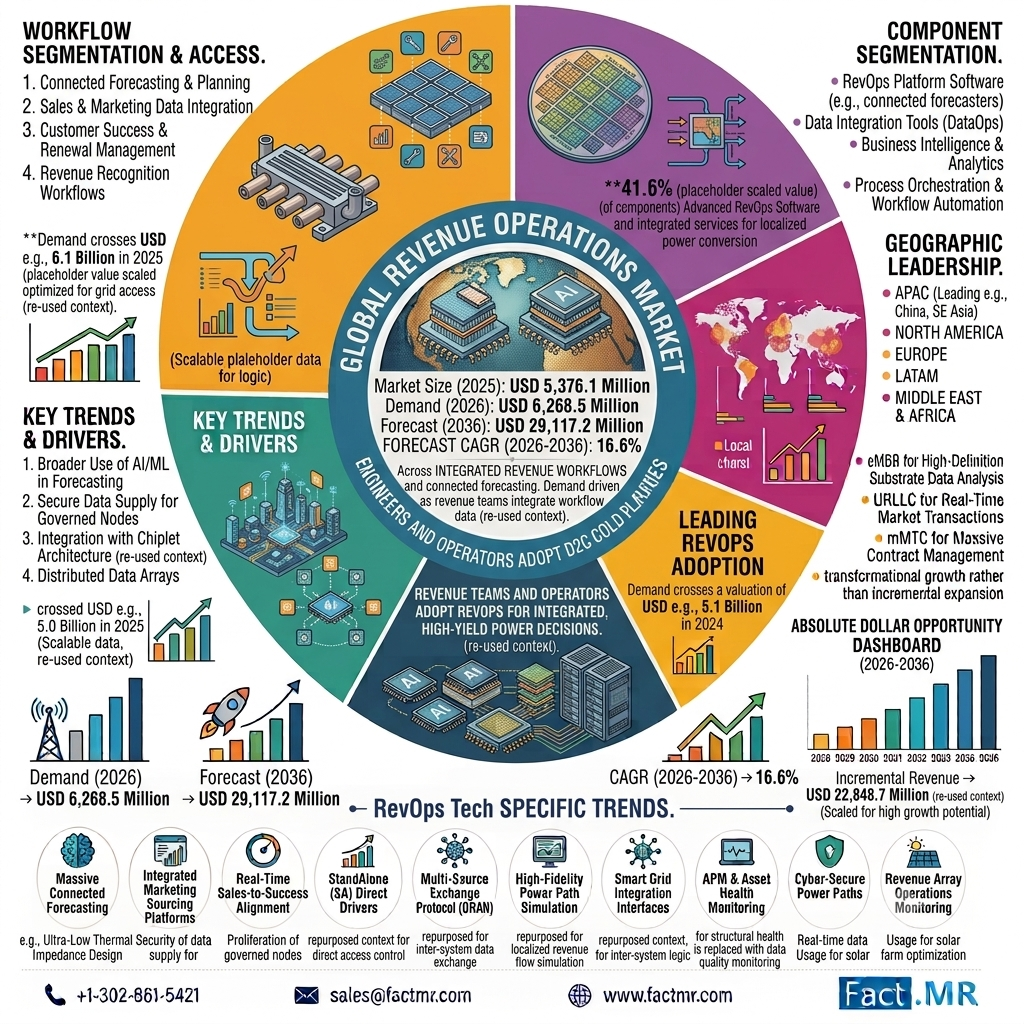
The global Revenue Operations (RevOps) Market is entering a new era of functional maturity. B2B and enterprise revenue leaders are moving rapidly beyond passive reporting dashboards and disconnected software systems, choosing instead to implement connected execution models that coordinate live pipeline actions across sales, marketing, and customer success teams.
Get detailed market forecasts, competitive benchmarking, and pricing trends:
According to strategic industry research published by Fact.MR, a premier market research and competitive intelligence provider, the global RevOps market reached a significant valuation of USD 5,376.1 million in 2025.
Driven by an absolute corporate requirement for unified pipeline data and automated go-to-market (GTM) processes, market demand is projected to rise from USD 6,268.5 million in 2026 to USD 29,117.2 million by 2036. This aggressive growth vectors an absolute dollar opportunity of USD 22,848.7 million, sustained by a high-performing compound annual growth rate (CAGR) of 16.6% over the 2026–2036 forecast decade.
Strategic Market Projections & Segment Insights
The core bottleneck in corporate revenue generations is no longer lead generation—it is operational friction caused by disconnected information handoffs between CRMs, sales activity systems, and post-sale account records. Modern RevOps platforms resolve this by applying shared data architectures and governed workflow automations.
- Dominant Component (Software): The Software segment commands the market, expected to account for 7% share in 2026. This large footprint is sustained by intense enterprise demand for a singular, centralized pipeline state and cross-team workflow control that unifies disparate commercial tools.
- Leading Deployment Model (Cloud):Cloud deployment leads the operational landscape, projected to capture a 6% share in 2026. Distributed sales teams and recurring cloud-to-cloud integration requirements make cloud infrastructure the standard choice for modern RevOps engineering.
- Leading Organization Size (SMEs): The Small & Medium Enterprise (SME) segment represents a critical 3% share in 2026. This positioning is shaped by the growing availability of preconfigured, low-administration RevOps systems that provide immediate visibility without heavy internal engineering overhead.
- Leading Application (Workflow Automation):Workflow Automation represents the primary application, estimated at a dominant 5% share in 2026. This high share is attributable to repeated routing, automated account reassignment, and complex deal approval tasks across revenue cycles.
- Primary End-Use Industry (BFSI): The Banking, Financial Services, and Insurance (BFSI) vertical secures the largest end-use position, forecast at a 0% share in 2026. BFSI operations require highly controlled customer records and multi-layered approval structures to satisfy rigid corporate compliance and audit protocols.
Analyst Perspective
"Revenue operations is rapidly becoming a data governance and control problem before it becomes an automation problem," states Shambhu Nath Jha, Senior Analyst at Fact.MR. "Modern pipeline reviews frequently fall apart because of uncoordinated CRM updates and fragmented historical data. The market is strongly shifting toward platforms that preserve data lineage and context across forecasts. RevOps providers must successfully blend clean API integrations with explicit, revocable agent controls, ensuring that automated actions remain fully auditable by commercial finance and IT compliance leaders."
Production vs. Consumption Economy Analysis
The revenue operations market operates as an interdependent network of algorithmic software production and commercial revenue consumption.
The production economy for RevOps software—specifically advanced forecasting algorithms, conversation intelligence models, and automated pipeline execution systems—is heavily centered in the United States, alongside specialized technology hubs in Western Europe and Australia. This is where advanced AI engines and enterprise data integration frameworks are built and updated.
The consumption economy, by contrast, maps directly to global enterprise density and digital service delivery scale. Emerging economic hubs across the Asia-Pacific region, led by India's massive software-services export sector, are scaling their commercial operations rapidly. These service exporters are becoming major consumers of RevOps infrastructure, utilizing cloud-native platforms to manage multi-tiered international contracts, optimize client renewals, and standardize pipeline assumptions across global territories.
Supply Chain, Value Chain, and Data Integration Insights
The modern RevOps value chain relies on turning un-structured activity data (emails, calendar entries, call recordings) and structured system data (CRM fields, billing records) into a clear pipeline state:
[Activity Ingestion] Emails, Calendar Schedules, Call Transcripts, Website Interactions
↓
[Data Normalization & Association] Mapping Activity to Accounts & Opportunity Objects
↓
[Core RevOps Engine] Pipeline Analytics, Predictive Health Scoring, Forecast Modeling
↓
[Workflow Automation Layer] Automated Account Assignment, SLA Routing, Alert Triggers
↓
[Connected GTM Execution] Clean Updates to CRM, ERP, Billing, and Customer Success Portals
A core point of friction in this value chain occurs at the integration stage. If an automated rule updates a CRM record without preserving the underlying source event, data integrity breaks down. Elite RevOps platforms isolate core system-of-record fields from derived signals, ensuring clear audit histories before downstream automations execute.
Strategic Procurement & Distribution Dynamics
Enterprise procurement and IT operations teams are completely re-engineering how they buy commercial software, prioritizing stack consolidation and explicit data controls:
- API-Led Stack Consolidation: Enterprises are shifting away from standalone point solutions (e.g., separate tools for conversation intelligence, contract management, and sales forecasting) in favor of broad, unified RevOps operating systems. This reduces platform procurement costs and removes integration blind spots.
- Traceable Forecast Revisions: Backed by corporate boards and financial compliance teams, organizations are mandating strict traceability behind all pipeline forecasts. Software must preserve the precise decision history and source event behind every material forecast update.
- API-First Distribution Infrastructure: RevOps software distribution has moved away from isolated tools to deeply embedded cloud platforms. Vendors leverage cloud marketplaces (such as AWS and Microsoft Azure) to deploy seamlessly across enterprise technology environments, allowing organizations to connect their sales records to cloud data lakes without custom infrastructure work.
Country Opportunity Assessment
- United States: Forecast to record a 9% CAGR through 2036. This performance is sustained by deep enterprise AI adoption and highly complex corporate revenue workflows across the Fortune 500.
- India: Projected to lead international growth with a high-performing 4% CAGR, driven by massive software-services delivery scale and expanding corporate interest in automated enterprise workflows.
- China: Estimated to achieve a 7% CAGR, supported by a rapid software-industry expansion and broad enterprise digitization programs.
- Australia: Anticipated to advance at a 4% CAGR by 2036, owing to aggressive AI and automated agent uptake across its information technology and enterprise sectors.
- United Kingdom: Estimated to post a 1% CAGR across the forecast decade, shaped by high cloud adoption rates across mid-market and enterprise business operations.
Technology and Innovation Outlook
Autonomous software agents and data-driven execution tools are redefining what is possible inside modern commercial workflows:
- Connected Observation and Execution: Top-tier platforms are combining pipeline visibility with automated execution. For instance, Gong introduced Gong Orchestrate alongside agent-based capabilities within its Revenue AI Operating System. This allows the platform to ingest account signals and instantly trigger governed workflow steps across commercial teams, reducing operational handoffs.
- Expert-Supervised Automation: RevOps platforms are adding governed AI agents that summarize account health, recommend renewal strategies, and prepare contract templates. Crucially, these innovation trends prioritize explicit user role permissions, ensuring that an automated agent cannot modify material CRM deal states without human approval.
Competitive Landscape Analysis
The global revenue operations market is highly competitive and rapidly evolving through continuous product updates and strategic platform consolidations. Key market participants profiled by Fact.MR include:
- Salesforce, Inc.
- HubSpot, Inc.
- io Inc.
- Clari Inc.
- Outreach, Inc.
- Keap (Infusionsoft)
- LeanData, Inc.
- Groove (A Clari Company)
- InsightSquared (Mediafly)
- RevenueCat, Inc.
Strategic competition is focused on building complete, end-to-end revenue ecosystems. Top-tier providers are consistently expanding their platforms' core capabilities to cover the full revenue lifecycle, moving aggressively to capture high-margin mid-market and enterprise platform budgets by providing pre-integrated workflow suites that replace fragmented, expensive point solutions.
To View More Report:
Industrial DataOps Frameworks Market: https://www.openpr.com/news/4579005/industrial-dataops-frameworks-market-to-surpass-usd-3-821-9
Solar Farm Predictive Maintenance Monitoring Market: https://www.openpr.com/news/4579035/solar-farm-predictive-maintenance-monitoring-market-to-reach

 English
 Arabic
 French
 Spanish
 Portuguese
 Deutsch
 Turkish
 Dutch
Dutch
 Italiano
 Russian
 Portuguese (Brazil)
 Greek
Greek