
Electronic Grade Isopropyl Alcohol Market Growth Driven by Semiconductor Demand
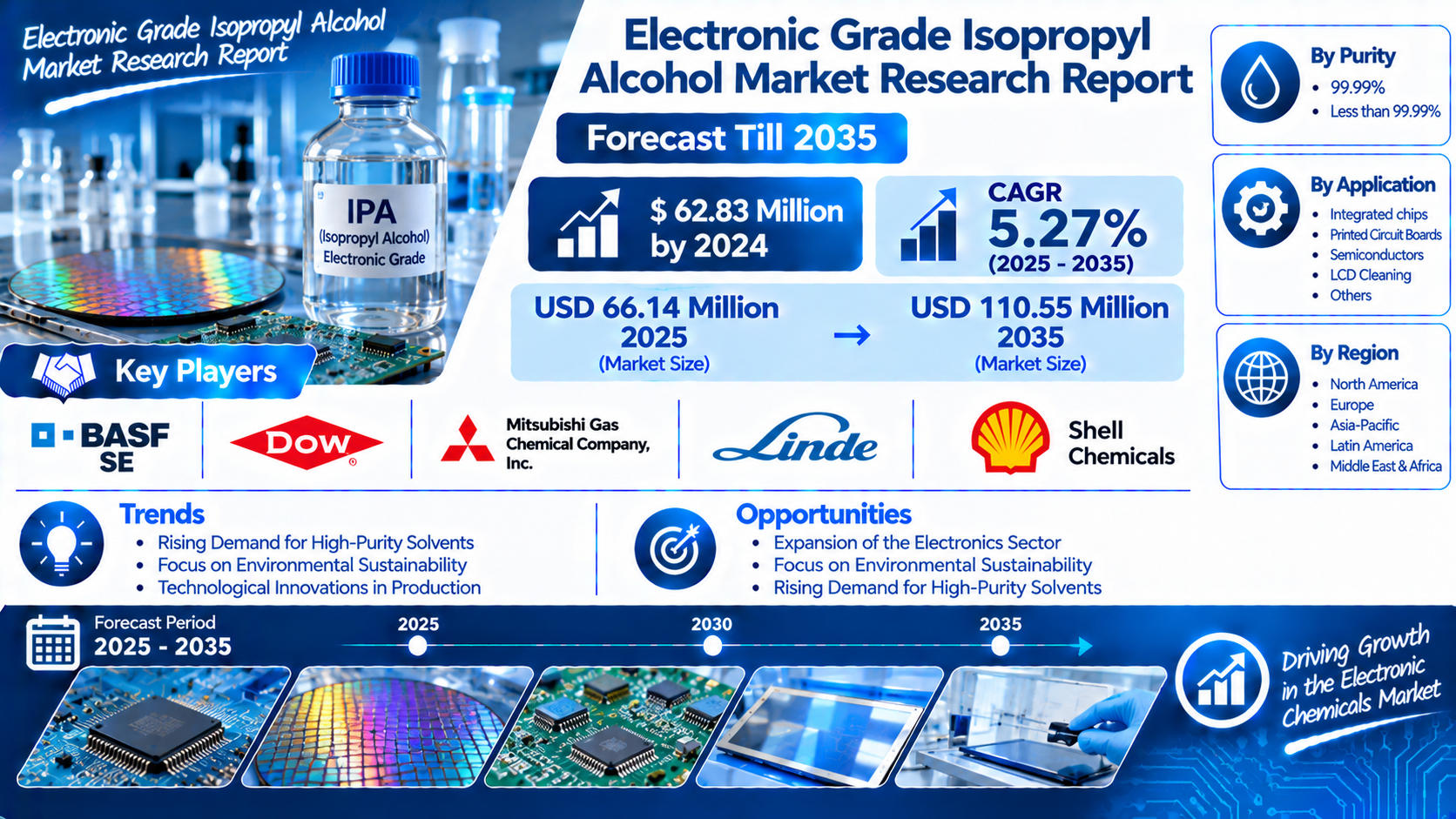
According to Market Research Future® (MRFR), the Electronic Grade Isopropyl Alcohol Market is projected to grow from USD 66.14 million in 2025 to USD 110.55 million by 2035, registering a compound annual growth rate (CAGR) of 5.27% during the forecast period of 2025–2035. The market was valued at USD 62.83 million in 2024. Demand is closely connected to the need for high-purity cleaning solvents in electronics manufacturing, where contamination control and surface cleanliness are important to production quality. Applications across integrated chips, printed circuit boards, semiconductors, and LCD cleaning contribute to the market's demand base.
Electronics Manufacturing Supports Solvent Demand
Electronic grade isopropyl alcohol (IPA) is used in electronics-related cleaning processes because it can help remove oils, residues, and other contaminants from suitable surfaces. Its application depends on the materials being cleaned, the process conditions, and the purity specifications required by manufacturers. In electronics production, even small amounts of unwanted contamination can affect component performance or interfere with subsequent manufacturing steps. This makes solvent quality and consistency important considerations for industrial users.
The expansion of the electronics sector is a key opportunity for the market. Manufacturing processes for electronic components and devices involve multiple stages in which cleaning and surface preparation may be required. As production capacity and the range of electronic products develop, manufacturers continue to assess cleaning materials that can meet technical requirements without introducing unwanted residues. Electronic grade IPA can serve these needs in applications where its chemical properties and purity are appropriate.
Semiconductor manufacturing is one of the important application areas identified in the market. Production environments require strict control over particles, chemical residues, and other sources of contamination. High-purity solvents can support selected cleaning and maintenance processes, although the precise solvent and cleaning method depend on the specific fabrication stage and material compatibility. Demand from semiconductor users is therefore influenced by production activity, process specifications, and the quality standards maintained by manufacturers.
Applications Across Chips, Circuit Boards, and Displays
The market report identifies integrated chips, printed circuit boards, semiconductors, LCD cleaning, and other uses as application segments. Each application has distinct cleaning requirements. Integrated chip and semiconductor-related processes may require solvents that meet demanding purity specifications, while printed circuit board production can involve cleaning steps intended to remove selected residues from surfaces and assemblies.
Printed circuit boards are used in a wide range of electronic equipment. Their manufacturing and assembly processes can involve soldering, handling, and other operations that may leave residues requiring removal. Electronic grade IPA can be used in suitable cleaning applications, subject to compatibility with the board materials, components, and process requirements. Manufacturers must select cleaning methods that avoid damage to sensitive parts and meet the quality expectations of the finished product.
LCD cleaning is another application category. Display manufacturing and related processes require careful surface preparation to limit contamination that could affect product quality. Solvent selection depends on the surface material, cleaning objective, and manufacturing specifications. Electronic grade IPA may be considered for suitable cleaning tasks, but it is not universally appropriate for every display material or process.
These varied applications create a diversified demand base. However, the performance of electronic grade IPA depends on more than its nominal purity. Trace contaminants, water content, packaging, handling, and storage conditions can all matter when solvents are used in sensitive manufacturing environments.
Purity Grades and Product Quality
The market is segmented by purity into 99.99% and less than 99.99% categories. Purity requirements vary according to the intended application and the level of contamination control needed. The 99.99% category addresses applications requiring a high-purity solvent, while products below that level may be suitable for processes with different specifications. Buyers evaluate solvent grades against process requirements rather than relying on a single purity figure.
Consistency between batches is also important. Electronic manufacturers may require documentation and quality controls that help establish whether a solvent meets their specifications. Appropriate storage containers, controlled handling, and protection from contamination are relevant throughout distribution and use. Suppliers that can maintain consistent product quality and meet customer requirements may be better positioned to serve electronics manufacturing customers.
Sustainability and Production Technology Trends
Environmental sustainability is an increasingly important consideration in the specialty solvent sector. IPA is a volatile and flammable organic solvent, so its use requires suitable storage, handling, ventilation, and fire-safety controls. Manufacturers and industrial users may examine methods to reduce solvent losses, improve process efficiency, and manage emissions. Solvent recovery and reuse may be considered where technically and economically feasible and where recovered material can meet the required purity specifications.
Sustainability initiatives also encourage attention to waste management and resource utilization. Because electronic-grade applications can have strict quality requirements, recovered solvent cannot automatically be returned to every process. Any reuse approach must account for contamination risks, purification requirements, and the performance standards of the intended application.
Technological innovations in production offer another development pathway. Improvements in purification, quality monitoring, process control, and packaging can help suppliers deliver solvents with more consistent characteristics. As electronics manufacturing processes become more demanding, producers may need to strengthen their ability to control trace impurities and maintain product integrity from manufacturing through delivery.
Regional Market Landscape and Competitive Environment
The report covers North America, Europe, Asia-Pacific, Latin America, and the Middle East and Africa. Regional demand is influenced by the distribution of electronics manufacturing, semiconductor production, printed circuit board facilities, and related industrial activity. Differences in manufacturing capacity, investment, supply chains, and quality requirements can shape regional purchasing patterns.
Asia-Pacific is an important region to monitor because of its electronics manufacturing base and role in semiconductor and component supply chains. North America and Europe also represent relevant markets for advanced electronics production and industrial applications. Latin America and the Middle East and Africa complete the report's regional coverage, with opportunities influenced by the development of local manufacturing and distribution capabilities.
Key players identified in the market include BASF SE, Dow Inc., Mitsubishi Gas Chemical Company Inc., Linde plc, and Shell Chemicals. These companies are profiled in the competitive landscape. Competition may involve product purity, manufacturing and purification capabilities, quality assurance, supply reliability, technical support, and the ability to meet customer-specific requirements.
Market Outlook Through 2035
The electronic grade isopropyl alcohol market is forecast to reach USD 110.55 million by 2035, supported by a projected CAGR of 5.27% between 2025 and 2035. Expansion in electronics manufacturing, demand for high-purity solvents, and the need for reliable cleaning processes provide a supportive environment for market development.
Future growth will depend on the pace of electronics sector expansion and manufacturers' requirements for increasingly controlled production environments. Sustainability considerations and improvements in solvent purification and production technology will also influence supplier strategies. Companies that combine consistent purity, dependable supply, and effective quality management may be positioned to address the evolving needs of electronics manufacturers.

 English
 Arabic
 French
 Spanish
 Portuguese
 Deutsch
 Turkish
 Dutch
 Russian
 Romaian
 Portuguese (Brazil)
 Greek